
Diagnostics and Coding
Factory tool on every module, written findings
- Price range
- $165–$265
- Typical time
- 1–2 hours
$165–$1,800 · 1–8 hours
Most mysterious European-car faults are voltage faults, and the rest are water, connectors and modules; a shop with the factory tool reads what every module remembers and fixes the cause rather than the symptom.
Factory tools for eight brands, repairs covered by a 2-year/24,000-mile warranty
Symptoms
Problem
Battery flat after the car sits for a few days
Likely cause
A module that does not go to sleep, a stuck relay, an aftermarket device on a live circuit
The fix
Draw measured, the module identified in the gateway sleep data, the cause fixed
Problem
Dozens of faults across unrelated modules
Likely cause
Low voltage during cranking or a failing ground, not thirty failed modules
The fix
Battery, charging and ground path tested, then the memory cleared and re-read
Problem
Battery replaced elsewhere, warnings continue
Likely cause
Battery never registered, or the wrong type for the car's charging strategy
The fix
Correct AGM or EFB type registered and coded through the tool
Problem
Lighting, wiper or window faults on a BMW
Likely cause
Footwell module or FRM failure, often after a flat battery or a jump start
The fix
Module repaired or replaced and coded
Problem
Electrical gremlins after heavy rain
Likely cause
Water in the trunk floor, the footwell or the cowl reaching a module or a connector
The fix
Leak found and fixed, module dried, repaired or replaced, connectors cleaned
A modern BMW, Mercedes or Audi has dozens of control units that each wake, work and sleep on a schedule, and all of them watch their supply voltage. When a tired battery sags during cranking, several of them log an undervoltage fault at once, and the owner sees a cluster full of warnings that clear once the car is running. Replace the right module for the wrong reason and the warnings return with the next cold morning.
The charging system is just as particular. These cars use an intelligent battery sensor on the negative terminal and a charging strategy that adjusts the alternator to the battery's age and state. A new battery must be registered so the controller resets that strategy; without the registration a new battery is charged as though it were old, and an AGM battery fitted where an EFB was specified, or the other way around, is charged wrong from the first day.
That is why every electrical visit here begins with the battery, the sensor and the charging data through the tool, before anything else is blamed.
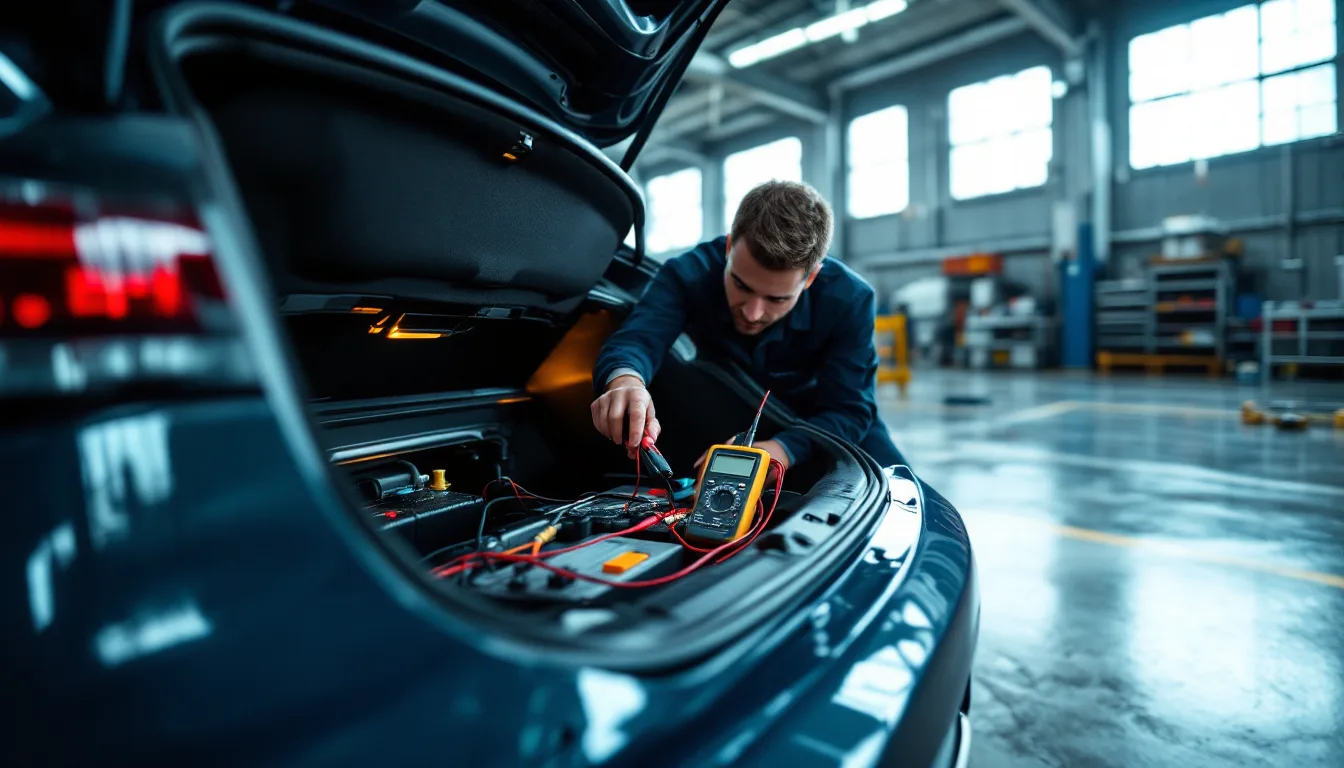
A drain is measured with the car asleep, which on these cars takes anywhere from fifteen minutes to over an hour after the last door closes, and the measurement is read with the ammeter in series and the door latches tricked shut. A draw above the brand's specification, typically under 50 milliamps once asleep, confirms the problem; the next step is finding the circuit.
The factory tool shortens that enormously. The gateway on most of these cars records which module woke the bus and when, and a module that keeps waking the network shows up in that data by name. From there the circuit is isolated and the cause found: a trunk latch microswitch on a Mercedes, a telematics module on an Audi, a comfort access antenna on a BMW, an aftermarket alarm or dash camera wired to a constant live on any of them.
BMW and MINI: the FRM footwell and light module that bricks itself after a voltage event, the CAS and FEM key and body controllers, the comfort access antennas, window regulators and the trunk wiring harness that breaks inside the hinge on wagons and hatchbacks. Mercedes: the SAM body modules, the seat and door control units, the trunk latch drain, the rear SAM that corrodes under a wet trunk floor and the ESL steering lock.
Audi and Volkswagen: the gateway, the comfort control module in the footwell that drowns when the sunroof drains block, the MMI and the instrument cluster, and door module wiring. Porsche: the front body controller, the gateway and the water-sensitive modules under the seats on the Cayenne. Jaguar and Land Rover: the BCM and the KVM, the tailgate and the rear body harnesses, and modules under the seats and in the trunk that suffer when a sunroof drain or a tailgate seal lets water in.
More than owners expect. The control units on these cars sit in footwells, under seats, in the trunk floor and behind the cowl, exactly where water collects when a sunroof drain blocks, a cowl seal splits, a door membrane fails or a tailgate seal ages. A BMW with wet carpet under the passenger seat, an Audi with a damp driver footwell, a Range Rover with water in the spare wheel well: each one is an electrical fault waiting for the first heavy rain.
When water is the cause, the repair here includes finding and fixing the leak. Drains are cleared, seals replaced, the carpet and the foam dried, the connectors cleaned and sealed and the module repaired or replaced and coded. Replacing the module without the leak repair is a job that comes back.
A wire that has chafed through on a trunk hinge, a connector pin that has corroded green, a ground strap that has lost its contact: these are repaired with the manufacturer's terminals, sealed splices and the correct wire gauge, not twisted and taped. The repair is tested under load and vibration, because a connection that reads fine on a meter at rest is what produces the intermittent fault nobody can find.
Where a harness section is beyond repair, the manufacturer's repair harness or a new section is fitted. Each repair is recorded on the invoice with the circuit and the location, so the next technician, here or anywhere, knows what was done.
The published range is $165–$1,800. A diagnosis that ends in a battery runs $320–$650 fitted and registered, and a registration or coding alone on a battery you supplied runs $85–$150. Parasitic drain tracing, wiring and connector repairs sit in the middle depending on how long the fault takes to reproduce. Body and comfort modules repaired or replaced and coded reach the top, and a module that needs full programming is quoted under module programming.
The estimate is written after the diagnosis and before any part is ordered, and the work is covered for 2 years parts and 2 years labor, up to 24,000 miles, nationwide. To book, call or text (817) 765-6604 with the year, model and a photo of the warnings, and say whether the battery has been replaced or jump-started recently.
Batteries are the type the brand specifies for the car, AGM or EFB, in the capacity the charging strategy expects, and are registered through the factory tool on every car that requires it. Modules, switches and harness sections are genuine or from the original-equipment supplier, with tested used modules where the brand allows alignment.
The price moves with the time an intermittent fault takes to reproduce, whether water damage adds a leak repair, and whether a module needs programming as well as fitting. Diagnosis stays its own line.


Pricing
| Service | Price range | Typical time |
|---|---|---|
| Battery registration or coding on a battery you supplied | $85–$150 | 1 hour |
| Battery supplied, fitted and registered, AGM or EFB | $320–$650 | 1–1.5 hours |
| Parasitic drain tracing and repair | $265–$700 | 2–5 hours |
| Body or comfort module repaired or replaced and coded | $500–$1,800 | 3–8 hours |
| Electrical diagnosis across every module | $165–$265 |
Typical Dallas independent-shop ranges; the time an intermittent fault takes to reproduce and whether a module needs coding set the figure, written before work starts.
The offer
Risk reversal
Covered for 2 years parts and 2 years labor, up to 24,000 miles, nationwide
No deposit, no card online: you approve the written range before any part is ordered
Published range
$165–$1,800
1–8 hours
Brands
BMW
3 Series E90, F30, G20, 5 Series E60, F10, G30, X3 and X5 E83, E70, F25, F15, G01, G05
Mercedes-Benz
C-Class W204, W205, W206, E-Class W212, W213, S-Class W221, W222
Audi
A4, A5 and Q5 B8, B9, 8R, FY, A6 and A7 C7, C8, A3 and S3 8V, 8Y
Volkswagen
Golf and GTI Mk5, Mk6, Mk7, Mk8, Jetta A5, A6, A7, Passat B6, B7 and the NMS
Land Rover
Range Rover L322, L405, L460, Range Rover Sport L320, L494, L461, Discovery LR3, LR4 L319 and Discovery 5 L462
Jaguar
XF X250 and X260, XJ X351, XE X760 and F-Pace X761
MINI
R50, R52, R53, R56, R55, R57, R58, R59, R60 Countryman and R61 Paceman
Porsche
911 996, 997, 991, 992, Boxster and Cayman 986, 987, 981, 718, Cayenne 955, 957, 958, 9YA
Questions
On any BMW, MINI or Mercedes built in roughly the last fifteen years, and on most Audi, VW, Porsche, Jaguar and Land Rover cars with an intelligent battery sensor, yes. Registration resets the charging strategy for a new battery; coding is also needed when the type or the capacity changes. Without it the battery ages early and the modules keep logging undervoltage.
A load test checks the battery at rest; the car sees it during cranking and after a week of short trips. The battery sensor data and the undervoltage faults with their timestamps tell the real story, and a battery that passes a counter test often fails the car's own criteria. We test it the way the car does.
It can. A voltage spike when the cables come off, or a reversed connection, is a common cause of a dead FRM on a BMW or a gateway fault on an Audi. Use the jump points under the hood, not the battery, connect in the right order, and have the fault memory read afterward if warnings appear.
Often a single visit of two to five hours, because the gateway data names the module that keeps the bus awake. A drain that only appears under certain conditions, after rain or after a specific door is used, can need the car overnight so the shop measures it asleep in the morning.
Yes, on a circuit that sleeps with the car and with a fused connection, which is the difference between an accessory and a drain. If a device installed elsewhere is the cause of a flat battery, the fix is usually to move it to the right circuit, not to remove it.
Cold raises the cranking current and lowers the battery's voltage under load at the same time, so a battery on the edge sags further on a cold start and several modules log undervoltage at once. The warnings clear once the alternator takes over. The battery, the sensor and the ground path are the first three things checked.
Related
Factory tool on every module, written findings

Modules flashed and coded to your VIN
Book Electrical Repair in Dallas
Electrical diagnosis and repair for European cars in Dallas: batteries registered through the tool, parasitic drains traced, wiring and connector repairs, comfort and lighting modules, and the voltage-related faults that fill a modern car's memory.